
Understand a familiar moment
Ask why an object speeds up, a shadow forms or a device warms.

Observe. Model. Understand.
A moving bicycle. A rainbow. A circuit that lights up. Connect familiar experiences with motion, energy and clear mathematical reasoning—so a formula becomes an idea you understand.
Explore the ideas first. Choose a class only when you need one.
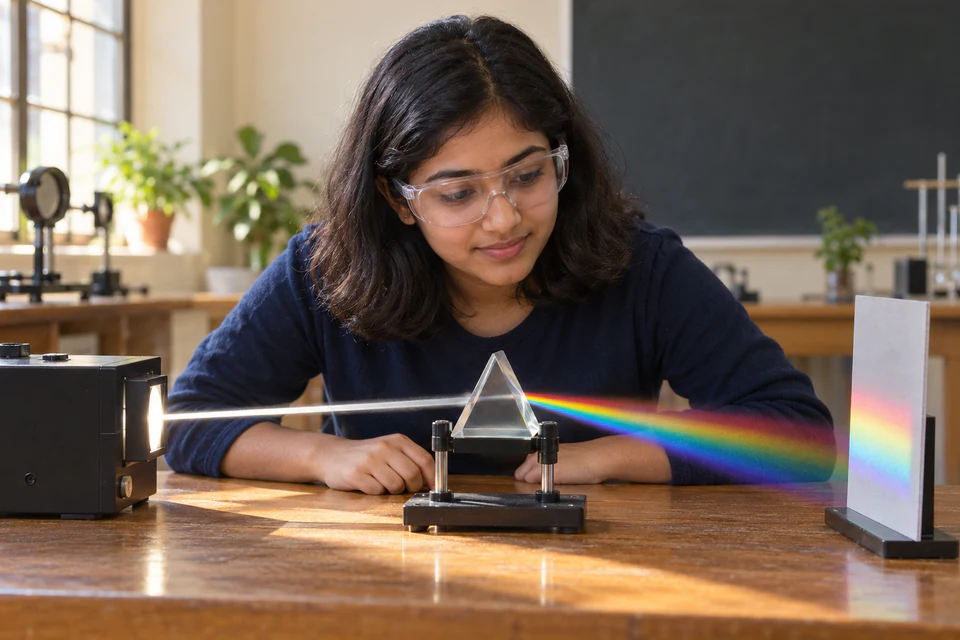
See the phenomenon. Understand the idea.
More than a school subject
Build understanding you can use—inside a lesson and in the world around you.
Ask why an object speeds up, a shadow forms or a device warms.

Connect a description, diagram, graph and equation instead of treating them separately.

Identify the quantities and assumptions before choosing a formula.

Use units, estimates and the situation itself to judge whether a result makes sense.
Explore and learn
Open an area for a clear starting point, a useful question and an everyday connection.
These are broad subject areas, not official chapters for a particular board or class.
 1. Motion and forcesConnect changes in position and motion with forces and useful models.
Make it realA journey takes 20 seconds to cover 120 metres. Its average speed is 6 m/s; that alone does not tell you its speed at every instant.
 2. Light and opticsUse rays and observations to reason about what we see.
Make it realA straw looks bent in water. Start with the change in the path of light—not a change in the straw itself.
 3. Electricity and circuitsBuild a connected picture of current, potential difference and circuit behaviour.
Make it realTwo circuit diagrams may look different on a page yet have the same connections. Trace the path before deciding.
 4. Waves and soundDescribe repeating patterns and connect them with sound and other wave behaviour.
Make it realA sound can be louder without having a higher pitch. Which wave properties describe those different changes?
 5. Heat and energyFollow energy transfers and explain changes without losing track of the system.
Make it realA hot cup cools. Ask where energy is transferred and which parts of the surroundings are involved.
Need the chapters for a particular curriculum?
A number with meaning
What is the average speed for this journey?
A quick preview—not a graded test. Choose an answer and see the reasoning.A clearer way to learn
Begin with a real situation and identify what needs explaining.
Use a diagram and a worked example to connect the relevant quantities.
Work through a question with reasoning, units and a clear method.
Ask whether the answer fits the model and the situation.

About this subject
Physics explains patterns in the physical world—from everyday motion and light to electrical and thermal processes. Understanding grows when you can connect an observation with a model and explain what an equation means.
EveryAgeLearn connects the idea, the worked example and the question that follows. Instead of choosing a formula by habit, you can practise identifying the quantities, following the units and checking what your answer says about the situation.
Your learning journey
Only actual mapped boards, classes and stages appear here. A broad subject introduction is not a combined syllabus.
Practical demonstrations require appropriate equipment and supervision. Available school pathways below do not imply a separate competitive-exam course.
Mapping: Aligned to the Cambridge Pathway (Primary, Lower Secondary, IGCSE, International AS & A Level) · 2025–26 series · Reviewed 2026-08-29. Explanations and practice support learning; this is not a reproduction of an official syllabus.

Choose one idea and turn a familiar phenomenon into a clear explanation.