
Read with understanding
Find meaning, follow a story and connect new information with what you already know.

Explore. Read. Express. Grow.
Build strong reading, writing and communication skills through engaging lessons, real examples and guided practice — for every learner, at every stage.

“Words open
a bigger world.”
More than a school subject
English helps learners make sense of ideas, find their voice and take part in the world around them.
Find meaning, follow a story and connect new information with what you already know.

Put your thoughts into clear words — in schoolwork, messages and everyday conversations.

Ask questions, notice a writer’s choices and explain an interpretation with evidence.

Listen to other perspectives and share your own with purpose, care and confidence.
Explore the subject
From recognising words to interpreting ideas, these broad areas show what English can help you understand and use.
These are subject areas, not official chapters for a particular board or class. Open an area for an explanation and an everyday example.
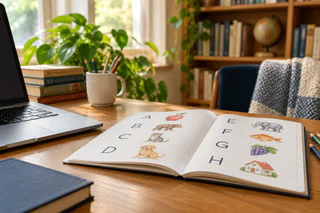 1. FoundationsLetters and sounds · Words and meanings · Simple sentences · Building vocabulary
Everyday exampleHear the first sound in ‘book’, read the word, then use it in a sentence: ‘I am reading a book.’
 2. Reading & comprehensionReading skills · Comprehension strategies · Different text types · Practice passages
Everyday exampleRead a short news story, explain what happened and point to the details that support your understanding.
 3. Grammar & writingParts of speech · Sentence structure · Paragraph writing · Editing and improvement
Everyday exampleTurn a quick note to a teacher into a clear, polite message that explains your reason and makes a specific request.
 4. Literature & expressionPoems and stories · Characters and themes · Creative writing · Speaking with confidence
Everyday exampleRead a poem, choose a line you like and explain the picture or feeling its words create.
Need to match English to a specific curriculum?
A clearer way to learn
Start with a clear explanation in plain language.
See the reasoning, not just a model answer.
Try targeted questions and use feedback to revisit an idea.
Track your progress and return to what needs attention.

About this subject
English brings reading, writing and communication together. It gives learners ways to discover new worlds, organise their thinking and share ideas — in school and in everyday life.
EveryAgeLearn connects explanations with examples and practice so you can see how an idea works, try it yourself and use feedback to decide what to revisit. When curriculum alignment matters, you can also browse the mapped English content for an available board and class below.
Your learning journey
Find the path that matches your learner's stage. Choose an available class to browse its mapped chapters and concepts.
Only classes with mapped English content are selectable. A stage card is a browsing shortcut, not a combined syllabus.
Explore and learn
Browse Cambridge Lower Secondary (Classes 6–8) English. Open a group to see the actual mapped chapter names, concepts and learning activities.
The four groups below organise your browsing. They do not replace Cambridge's mapped chapter titles.
1. FoundationsLetters and sounds · Words and meanings · Simple sentences · Building vocabulary0 mapped concepts for Cambridge Lower Secondary (Classes 6–8)No concepts are mapped to this browsing group for Cambridge Lower Secondary (Classes 6–8) yet. Explore another group or choose an available class.
2. Reading & comprehensionReading skills · Comprehension strategies · Different text types · Practice passages2 mapped concepts for Cambridge Lower Secondary (Classes 6–8)3. Grammar & writingParts of speech · Sentence structure · Paragraph writing · Editing and improvement1 mapped concept for Cambridge Lower Secondary (Classes 6–8)4. Literature & expressionPoems and stories · Characters and themes · Creative writing · Speaking with confidence0 mapped concepts for Cambridge Lower Secondary (Classes 6–8)No concepts are mapped to this browsing group for Cambridge Lower Secondary (Classes 6–8) yet. Explore another group or choose an available class.
Mapping: Aligned to the Cambridge Pathway (Primary, Lower Secondary, IGCSE, International AS & A Level) · 2025–26 series · Reviewed 2026-08-29. Explanations and practice support learning; this is not a reproduction of an official syllabus.

Start learning English on EveryAgeLearn today.