Free to explore30-day trial of personalised learningEvery board, every ageUnderstand, don't just memorise

Choose a way to learn

Find the way of learning that clicks for you

Read a clear explanation. Connect it to a story. See the idea, try a question and bring it together with a recap. Explore different approaches to the same concept — and find a helpful next step.

  • Real examplesMake an idea concrete.
  • More than one approachTry another explanation.
  • Practice with purposeExplain your reasoning.

Ways to learn — with a real preview of each

One idea, six approaches. Explore these complete fractions examples before you sign in.

Try a different approach whenever it helps. Your chosen path determines which formats are available in each lesson.

Concept explanation

A plain-language overview with a clear example, the key idea, and links to related concepts.

Helpful for: Meeting a new idea

Example — what does 3/4 mean?

A fraction shows equal parts of a whole. In 3/4, the denominator, 4, tells us how many equal parts make the whole. The numerator, 3, tells us how many parts we take.
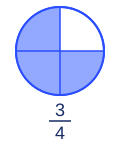
A circle split into four equal quarters, with three quarters coloured blue; the fraction is three quarters.
3 of 4 equal parts

Story or scenario

A short, relatable context that makes a concept memorable and meaningful.

Helpful for: Connecting an idea to everyday life

Example — sharing a chocolate bar

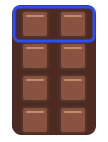
Aarav shares an 8-square chocolate bar with 3 friends: 4 children in all. Each child gets 8 ÷ 4 = 2 squares — that is 2/8, or 1/4, of the bar.

Eight equal chocolate squares arranged in two columns and four rows; two squares are highlighted as one child’s quarter share.
Equal sharing

Visual explanation

A diagram, worked example, grouping, number line, or process view of the idea.

Helpful for: Seeing how the parts connect

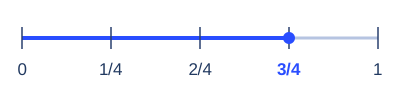
Example — a number line for 3/4

A number line from zero to one divided into four equal steps, with three quarters marked after the third step.
Count 3 of the 4 equal steps from 0 to 1. You land on 3/4.

Voice narration

An optional read-aloud format with a written transcript. This public example is text only; narration is a signed-in feature where supported.

Helpful for: Following an explanation in words

Example — narration transcript

Written transcript · no audio on this page
“Let us read three-quarters. The bottom number, four, tells us the whole is cut into four equal parts. The top number, three, tells us we take three of them.”

Optional narration is a signed-in feature where supported; this public preview is text only.

Practice set

A short practice activity mapped to the selected concept and difficulty.

Helpful for: Checking your understanding

Example — practice question

A cake is cut into 6 equal pieces and 2 are eaten. What fraction is left?

Revision sheet

A compact recap of terms, methods, and common mistakes to avoid.

Helpful for: Revisiting key ideas and common mistakes

Example — fractions recap

Fraction terms and equivalent fractions
Key termMeaning
NumeratorNumber of parts we take
DenominatorTotal equal parts in the whole
Equivalent1/2 = 2/4 = 4/8

Watch the common mistake: 1/2 + 1/4 is not 2/6. Make the denominators equal first: 2/4 + 1/4 = 3/4.

Learning that fits everyday life

At home, in school or on the go: choose a clear explanation, revisit an example and practise at your own pace.

  • Fits your screen

    Explore this website on phones, tablets and computers.

  • Less to download

    Right-sized images keep these previews light, without needing to play media.

  • Read without sound

    These written examples work without audio or autoplay.

  • You stay in control

    Use your keyboard, zoom the page and take your time.

An internet connection is needed for this website. Resource and narration availability may vary by lesson and account.

A laptop, tablet and phone arranged on a bright study desk, illustrating learning across different screen sizes

Ready to see an idea click?

Try a free written sample lesson first. When you are ready, create an account to start your learning path.